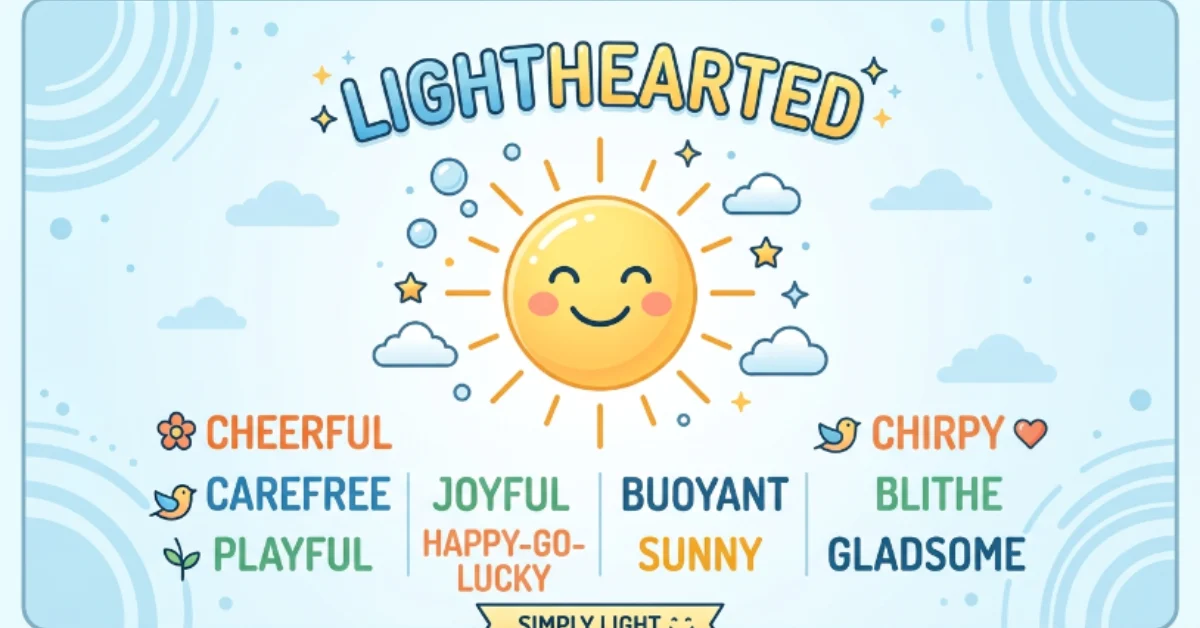
Looking for a synonym of lighthearted? Carefree is usually the closest match, but it’s not always the best choice. Depending on your context, cheerful, playful, easygoing, or upbeat may fit better.
This guide explains what each synonym means, when to use it, and how to choose the word that sounds most natural.
Synonyms of Lighthearted at a Glance
| If you want to describe… | Best synonym |
|---|---|
| Someone free from worry | Carefree |
| A positive personality | Cheerful |
| A humorous tone | Playful |
| A relaxed temperament | Easygoing |
| An optimistic mood | Upbeat |
| A friendly, sociable person | Jovial |
| Optimism after setbacks | Buoyant |
| A warm, optimistic outlook | Sunny |
What Does “Lighthearted” Mean?
Lighthearted describes someone or something that is cheerful, relaxed, and not overly serious. It can describe people, conversations, books, movies, jokes, or an overall atmosphere. The best synonym depends on the context you’re writing about.
Carefree
Meaning: Free from worry or stress; relaxed and unconcerned.
Best used when: Describing someone’s attitude or lifestyle.
Common collocations
- carefree attitude
- carefree spirit
Examples
- She has a carefree attitude that makes stressful situations feel easier.
- They enjoyed a carefree holiday by the beach.
Avoid using it when: You mean careless or irresponsible.
Cheerful
Meaning: Consistently happy, optimistic, and pleasant.
Best used when: Describing a positive personality or atmosphere.
Common collocations
- cheerful smile
- cheerful personality
Examples
- Her cheerful smile welcomed every customer.
- The office maintained a cheerful atmosphere throughout the event.
Playful
Meaning: Fun-loving, humorous, and inclined to joke.
Best used when: Talking about humor, conversations, or creative writing.
Common collocations
- playful tone
- playful banter
Examples
- The article uses a playful tone without losing clarity.
- Their playful banter made the dinner more enjoyable.
Avoid using it when: The situation requires a serious or formal tone.
4. Easygoing
Meaning: Calm, relaxed, and not easily upset.
Best used when: Describing someone’s temperament.
Common collocations
- easygoing personality
- easygoing nature
Examples
- Our manager is easygoing and listens to everyone’s ideas.
- She’s so easygoing that unexpected changes never bother her.
Upbeat
Meaning: Positive, hopeful, and optimistic.
Best used when: Describing a mood, speech, article, or conversation.
Common collocations
- upbeat tone
- upbeat outlook
Examples
- The presenter kept an upbeat tone throughout the seminar.
- Despite the setback, the team remained upbeat.
Jovial
Meaning: Cheerful, friendly, and full of good humor.
Best used when: Describing warm and sociable people.
Common collocations
- jovial personality
- jovial manner
Examples
- His jovial personality made everyone feel at home.
- The guests enjoyed the host’s jovial manner.
Buoyant
Meaning: Cheerful and optimistic, especially after difficulties.
Best used when: Describing resilience and positive thinking.
Common collocations
- buoyant mood
- buoyant spirit
Examples
- She stayed buoyant despite facing several challenges.
- The company remained buoyant after a difficult year.
Avoid using it when: You simply mean someone is friendly or happy.
Sunny
Meaning: Warm, optimistic, and consistently positive.
Best used when: Describing a person’s outlook, attitude, or personality.
Common collocations
- sunny disposition
- sunny outlook
Examples
- Her sunny disposition made the workplace more enjoyable.
- Even on difficult days, he kept a sunny outlook.
Whimsical
Meaning: Imaginative, playful, and pleasantly unusual.
Best used when: Describing creative writing, art, designs, or storytelling.
Common collocations
- whimsical tone
- whimsical story
Examples
- The novel has a whimsical tone that appeals to readers of all ages.
- She decorated the nursery with whimsical illustrations.
Avoid using it when: You simply mean cheerful or optimistic.
Jaunty
Meaning: Lively, confident, and stylishly cheerful.
Best used when: Describing music, fashion, movement, or literary writing.
Common collocations
- jaunty tune
- jaunty walk
Examples
- He entered the room with a jaunty smile.
- The film begins with a jaunty melody.
Avoid using it when: Writing for a general audience that may not know the word.
Merry
Meaning: Cheerful, joyful, and full of celebration.
Best used when: Describing holidays, celebrations, or festive occasions.
Common collocations
- merry celebration
- merry laughter
Examples
- The streets were filled with merry music and laughter.
- Everyone was in a merry mood during the festival.
Blithe
Meaning: Cheerfully unconcerned or carefree.
Best used when: Literary writing or describing someone who seems unconcerned.
Common collocations
- blithe attitude
- blithe disregard
Examples
- She remained blithe despite the uncertainty around her.
- His blithe confidence surprised everyone.
Avoid using it when: Writing in a very casual style, as it’s less common in everyday English.
Chipper
Meaning: Cheerful, lively, and energetic.
Best used when: Informal conversations about someone’s mood.
Common collocations
- chipper mood
- chipper voice
Examples
- She sounded surprisingly chipper early in the morning.
- He stayed chipper throughout the long journey.
Sprightly
Meaning: Energetic, lively, and full of enthusiasm.
Best used when: Describing older people, performers, or energetic personalities.
Common collocations
- sprightly manner
- sprightly step
Examples
- The eighty-year-old woman remained remarkably sprightly.
- He greeted visitors with a sprightly smile.
Breezy
Meaning: Relaxed, casual, and pleasantly informal.
Best used when: Describing writing, conversation, or someone’s communication style.
Common collocations
- breezy style
- breezy conversation
Examples
- The author adopts a breezy writing style that’s easy to follow.
- We had a breezy conversation over coffee.
Avoid using it when: Referring to situations that require seriousness or emotional depth.
Vivacious
Meaning: Attractively lively, energetic, and full of life.
Best used when: Describing outgoing personalities.
Common collocations
- vivacious personality
- vivacious smile
Examples
- Her vivacious personality made her popular with everyone.
- The interviewer appreciated her vivacious energy.
Convivial
Meaning: Friendly, welcoming, and enjoyable in social settings.
Best used when: Describing gatherings, hosts, or social environments.
Common collocations
- convivial atmosphere
- convivial gathering
Examples
- The restaurant offered a convivial atmosphere.
- Their convivial dinner lasted well into the evening.
Gleeful
Meaning: Extremely happy and openly delighted.
Best used when: Describing obvious excitement or joy.
Common collocations
- gleeful smile
- gleeful laughter
Examples
- The children watched with gleeful excitement.
- She gave a gleeful laugh after hearing the good news.
Animated
Meaning: Full of energy, enthusiasm, and lively expression.
Best used when: Describing conversations, discussions, or facial expressions.
Common collocations
- animated discussion
- animated conversation
Examples
- They had an animated discussion about the new project.
- His face became animated as he shared the story.
Happy
Meaning: Feeling or showing pleasure and contentment.
Best used when: Describing someone’s emotional state.
Common collocations
- happy smile
- happy ending
Examples
- She looked happy after hearing the good news.
- We were happy to help the new team member.
Note: Happy describes an emotion, while lighthearted describes an overall mood or attitude.
Optimistic
Meaning: Hopeful and confident about the future.
Best used when: Describing someone’s outlook or expectations.
Common collocations
- optimistic outlook
- optimistic attitude
Examples
- Investors remain optimistic about the company’s future.
- She’s optimistic that everything will work out.
High-Spirited
Meaning: Energetic, cheerful, and full of enthusiasm.
Best used when: Describing lively people, children, or celebrations.
Common collocations
- high-spirited children
- high-spirited performance
Examples
- The camp was full of high-spirited children.
- Their high-spirited celebration lasted all evening.
Lively
Meaning: Full of energy, activity, and excitement.
Best used when: Describing people, places, or conversations.
Common collocations
- lively discussion
- lively atmosphere
Examples
- We had a lively discussion about the book.
- The town has a lively nightlife.
Good-Humored
Meaning: Friendly, cheerful, and not easily annoyed.
Best used when: Describing patient and pleasant personalities.
Common collocations
- good-humored smile
- good-humored attitude
Examples
- He stayed good-humored despite the long delay.
- Everyone appreciated her good-humored nature.
Light-Hearted
Meaning: An alternative spelling of lighthearted, mainly used in British English or by some publishers.
Best used when: Following a style guide that prefers the hyphenated form.
Examples
- The novel has a light-hearted tone.
- They enjoyed a light-hearted conversation over dinner.
Note: Both lighthearted and light-hearted are correct. Always follow your chosen style guide consistently.
Careless (Not a True Synonym)
Meaning: Not giving enough attention or care.
Why it’s confusing
People sometimes mistake careless for carefree, but the meanings are very different.
Examples
- A careless mistake cost the team the match.
- He was careless with important documents.
Remember: Carefree is positive. Careless is usually negative.
Synonyms to Use with Caution
Some words appear in thesauruses alongside lighthearted, but they can change your intended meaning.
Flippant
Meaning: Treating serious matters with inappropriate humor or disrespect.
Common collocations
- flippant remark
- flippant response
Examples
- His flippant comment upset the audience.
- She was criticized for her flippant attitude.
Use it only when you want a negative meaning.
Frivolous
Meaning: Lacking seriousness or practical value.
Common collocations
- frivolous spending
- frivolous complaint
Examples
- The judge dismissed the frivolous lawsuit.
- Critics called the purchase frivolous.
Unlike lighthearted, frivolous usually sounds critical.
Commonly Confused Synonyms
These are commonly confused synonyms for lighthearted.
Carefree vs. Easygoing
- Carefree = free from worry.
- Easygoing = relaxed and pleasant with other people.
Examples
- She’s carefree and rarely worries about the future.
- He’s easygoing and easy to work with.
Cheerful vs. Happy
- Cheerful describes a person’s usual personality.
- Happy often describes a temporary emotion.
Examples
- She’s always cheerful at work.
- He felt happy after passing the exam.
Playful vs. Whimsical
- Playful focuses on humor and fun.
- Whimsical focuses on imagination and creativity.
Examples
- The puppy was playful all afternoon.
- The story has a whimsical ending.
Upbeat vs. Optimistic
- Upbeat describes a positive tone or mood.
- Optimistic describes confidence about the future.
Examples
- She gave an upbeat presentation.
- He’s optimistic about next year’s results.
Antonyms of Lighthearted
| Antonym | Best used for |
|---|---|
| Serious | Important situations |
| Somber | Sad or reflective moods |
| Grave | Very serious circumstances |
| Earnest | Sincere attitudes |
| Gloomy | Negative or depressing moods |
| Melancholy | Quiet sadness |
FAQs
What’s the closest synonym for lighthearted?
Carefree is the closest synonym because it emphasizes being relaxed and free from worry.
Which synonym is the most formal
Buoyant, optimistic, and untroubled are the most suitable choices for formal writing.
Which synonym is best for describing a person?
Carefree, cheerful, easygoing, and good-humored are excellent choices, depending on the personality you’re describing.
Which synonym is best for writing or conversation?
Playful, upbeat, and whimsical work especially well when describing tone.
Is flippant a synonym for lighthearted?
Not usually. Flippant often suggests disrespect, while lighthearted has a positive meaning.
What’s the opposite of lighthearted?
The most common antonyms are serious, somber, grave, and earnest.
Can lighthearted describe both people and situations?
Yes. It can describe people, conversations, books, movies, speeches, jokes, and overall atmosphere.
What’s the difference between lighthearted and carefree
Lighthearted can describe both people and things, while carefree is mainly used for people and their attitude.
Editor’s Picks
| Situation | Best Synonym |
|---|---|
| Free from worry | Carefree |
| Positive personality | Cheerful |
| Fun and humorous | Playful |
| Relaxed temperament | Easygoing |
| Optimistic tone | Upbeat |
| Friendly and sociable | Jovial |
| Resilient optimism | Buoyant |
| Creative charm | Whimsical |
Final Thoughts
The best synonym for lighthearted depends on your context, not just the dictionary definition. Carefree is the closest overall alternative, while cheerful, playful, easygoing, and upbeat each highlight a different shade of meaning. Choosing the right word will make your writing sound more natural, precise, and engaging.
Related Blogs: